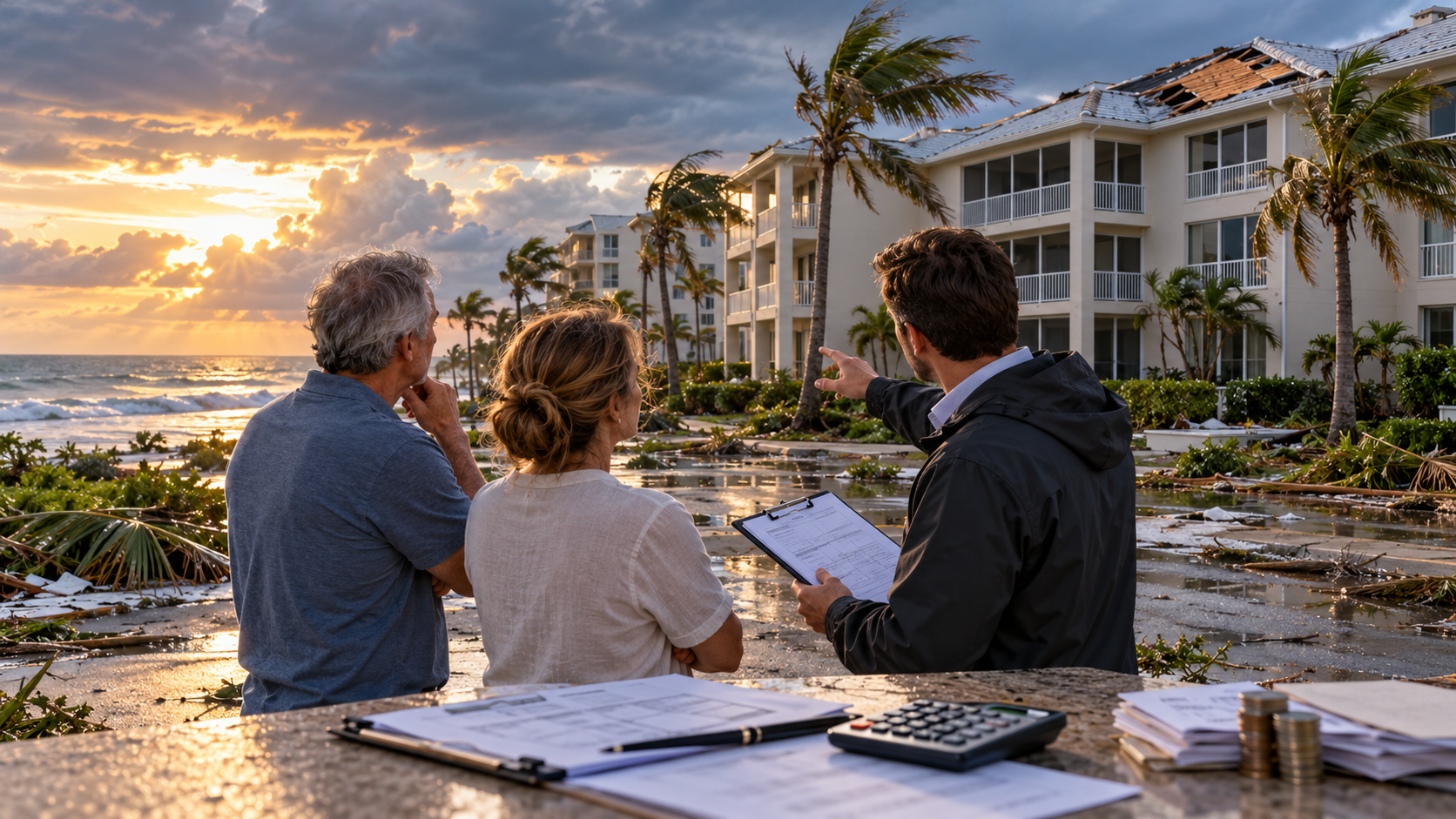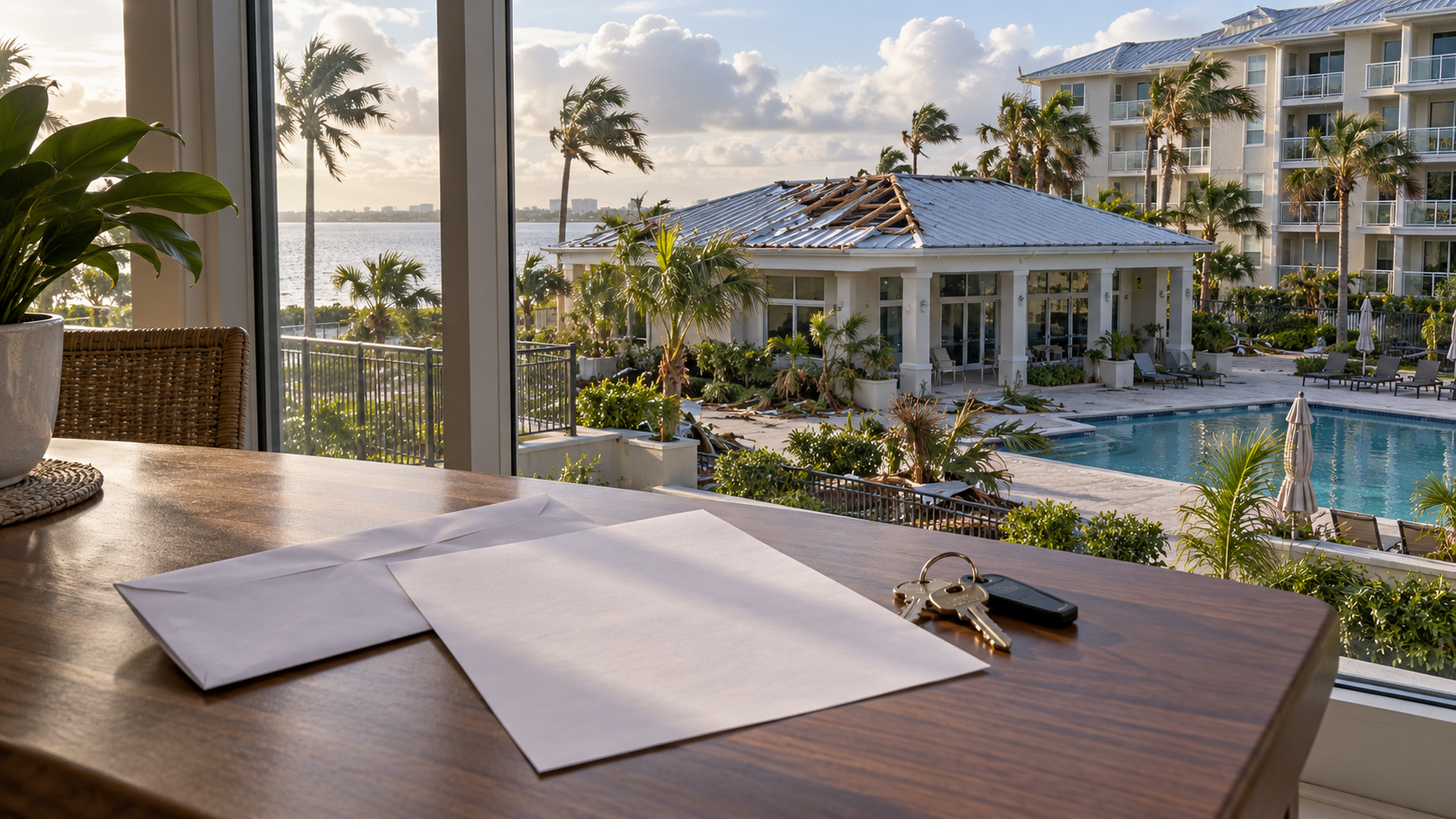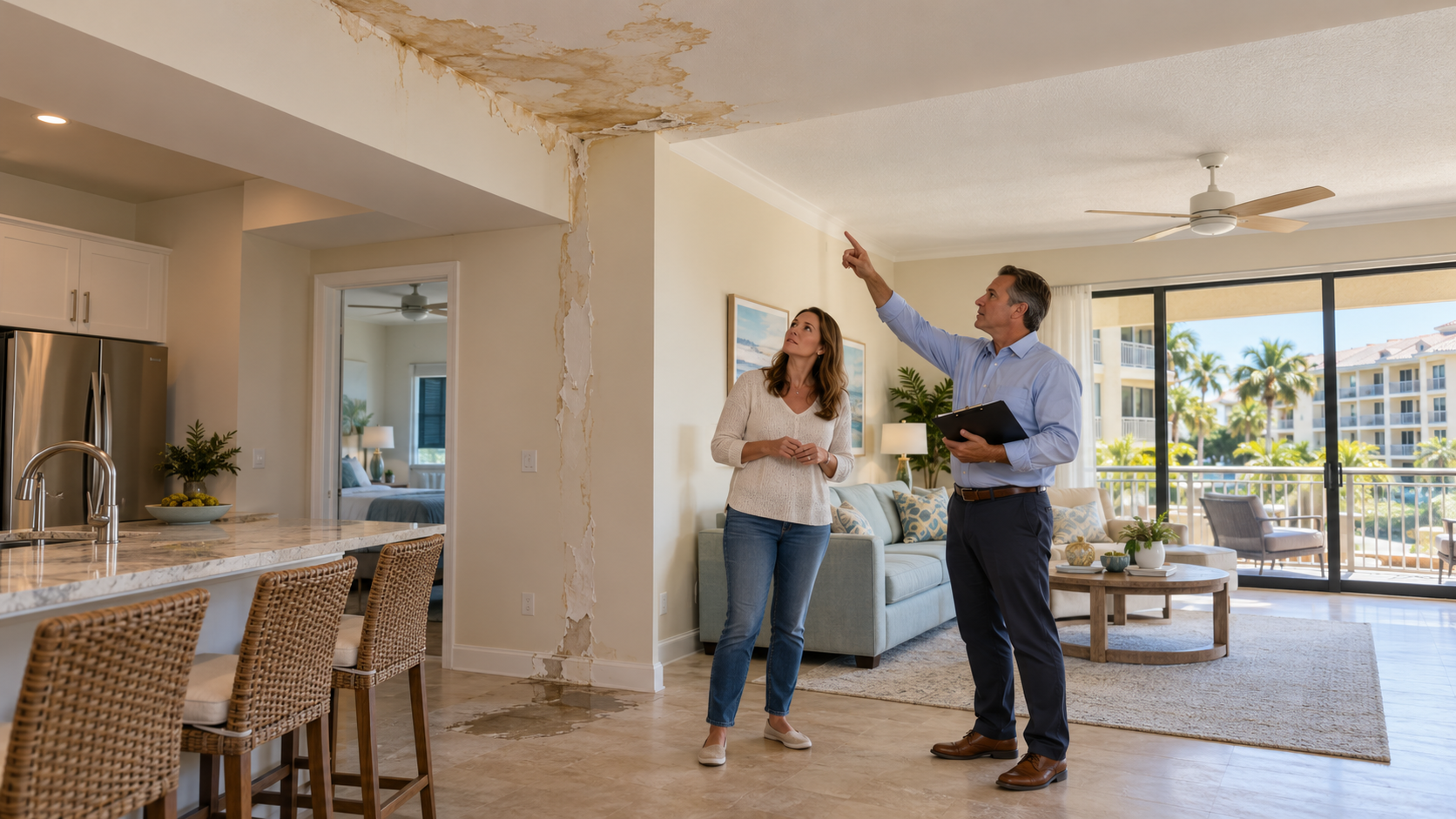
When a hurricane damages a condominium building in Florida, the insurance claim can involve more than repairing the roof, windows, or common areas. One of the biggest financial questions is: Who pays a condo association’s hurricane deductible?
In most cases, the condominium association is responsible for its master insurance policy deductible, which is generally treated as a common expense shared by unit owners. Depending on available funds and the condominium’s governing documents, the association may collect money through regular assessments or a special assessment.
However, the responsibility is not identical in every situation. Florida law provides exceptions, and individual condo insurance policies may offer limited protection against certain assessments.
At PICC FLA, we help Florida condominium owners navigate property insurance claims involving hurricanes, wind damage, roof damage, and other property losses. We understand that a hurricane claim can become confusing when an association’s master policy, individual condo policies, and unexpected assessments are involved.
Understanding how deductibles work can help you review your financial responsibility and determine which insurance coverage may apply.
What Is a Condo Master Policy Hurricane Deductible?
A condo master policy deductible is the portion of an insured property loss that remains the condominium association’s responsibility before the applicable insurance payment is calculated.
A condominium association’s master policy generally insures specified building components and common property, as required by Florida law and the applicable policy.
These may include:
- Building structures and shared roofs
- Exterior walls
- Certain structural components
- Hallways and common areas
- Other property insured by the association
Hurricane deductibles may differ from standard property insurance deductibles. Some policies calculate the deductible as a percentage of the applicable insured value rather than a fixed dollar amount.
This can create a substantial financial obligation after a hurricane.
Our guide on condo master policies versus individual condo insurance explains how these policies can work together when a condominium suffers property damage.
Who Is Responsible for Paying the Association’s Hurricane Deductible?
Under Florida Statutes section 718.111(11)(j), property insurance deductibles under policies maintained by a condominium association are generally common expenses.
This means the deductible is ordinarily an association expense rather than a charge automatically assigned to the owner of the most damaged unit.
However, Florida law includes exceptions, including certain losses involving a unit owner’s intentional conduct, negligence, or failure to comply with condominium requirements. The law also permits qualifying associations to adopt an alternative allocation of repair and reconstruction expenses through the required approval process.
Consequently, the financial responsibility may depend on:
- Florida condominium law
- The condominium declaration
- Applicable association provisions
- The nature of the property damage
- The master policy deductible
- Available association funds
- Any applicable statutory exceptions
We recommend reviewing these details before assuming that every unit owner must pay the same amount.
How Does the Association Pay Its Hurricane Deductible?
The association generally handles claims involving property insured under its master policy.
After a hurricane, the claim process may involve inspecting the damage, reviewing the coverage, estimating repair costs, and determining the applicable deductible.
If the association must fund a deductible, possible funding sources include available operating funds, legally available reserves, and assessments collected from unit owners.
The ability to use particular reserve funds depends on applicable restrictions and approvals.
If the association does not have sufficient available money, an additional assessment may become necessary.
Our hurricane and storm damage claim services explain how we assist Florida property owners with documenting and navigating hurricane-related insurance claims.
Can a Condo Association Issue a Special Assessment for Its Hurricane Deductible?
Yes. A condominium association may impose a special assessment to fund qualifying expenses resulting from hurricane damage, subject to applicable law and condominium requirements.
A special assessment is an additional charge collected from unit owners for expenses outside the adopted annual budget.
An HOA hurricane deductible special assessment may be discussed in condominium communities, although condominium associations and homeowners associations are governed by different legal requirements.
For Florida condominiums, special assessments may help address:
- Association insurance deductibles
- Qualifying property repair expenses
- Uninsured repair costs
- Other authorized expenses related to the hurricane loss
Florida law also establishes notice requirements for meetings considering nonemergency special assessments.
A special assessment should not automatically be treated as an insured loss under an individual condo policy.
Our guide on whether condo insurance covers a special assessment explains why the underlying reason for the assessment matters.
How Is a Hurricane Deductible Divided Among Condo Owners?
The amount charged to each unit owner generally depends on the allocation of common expenses established by the condominium declaration and applicable Florida law.
Not every condominium divides expenses equally.
For example, suppose an association must fund a $100,000 hurricane deductible. If the condominium has 50 units and its governing documents provide for equal allocation, each unit’s share would be $2,000.
However, a different condominium might allocate expenses according to each unit’s designated ownership interest.
The association should therefore examine its governing documents before calculating individual assessment amounts.
Florida Statutes section 718.115 generally requires common expenses to be assessed according to the proportions or percentages established in the condominium declaration, unless otherwise provided by law.
Can Individual Condo Insurance Cover a Hurricane Deductible Assessment?
Potentially.
Individual condominium insurance may include loss assessment hurricane deductible protection when an association charges unit owners for qualifying property loss expenses.
Florida Statutes section 627.714 requires residential condominium unit owner policies issued or renewed on or after July 1, 2010, to include at least $2,000 in qualifying property loss assessment coverage.
However, this does not mean every hurricane deductible assessment is automatically covered.
Coverage depends on whether the assessment arises from a direct property loss of a type covered by the unit owner’s policy, along with applicable limits, exclusions, and policy provisions.
The statutory loss assessment deductible cannot exceed $250 per direct property loss. If a deductible applies to other covered property damage sustained by the owner from the same loss, no separate loss assessment deductible applies.
Our article on condo loss assessment coverage explains how this protection works.
When Might Loss Assessment Coverage Not Pay the Deductible?
Not every special assessment qualifies for payment.
For example, an assessment for routine building maintenance is different from an assessment resulting from a covered hurricane loss.
Assessments involving the following expenses may not qualify:
- Ordinary maintenance
- Planned building improvements
- General reserve contributions
- Repairs unrelated to covered property damage
- Damage caused by excluded perils
- Expenses exceeding applicable loss assessment limits
Policy-specific restrictions may also affect assessments involving the association’s insurance deductible.
The nature of the loss is especially important. An assessment related to hurricane wind damage may be evaluated differently from one involving excluded flooding.
We recommend reviewing the assessment notice alongside the individual condo policy rather than assuming that all hurricane-related expenses qualify.
Does the Association’s Master Policy Cover Everything Inside a Condo?
No.
Florida law distinguishes between property that must be insured by the condominium association and property assigned to individual unit owners.
The association’s required property insurance generally excludes certain unit-specific interior items, including floor coverings, wall coverings, ceiling coverings, appliances, built-in cabinets, countertops, and personal belongings.
These items may fall under the owner’s individual policy, depending on its terms.
Following a hurricane, the master policy may address qualifying roof or structural damage while an individual policy may address certain damaged interior property.
This separation also means that the association’s hurricane deductible and an individual owner’s policy deductible are different obligations.
Our guide comparing condo insurance and HOA insurance responsibilities provides additional information about these distinctions.
What Documents Should Condo Owners Review After a Hurricane Assessment?
If you receive a special assessment after a hurricane, we recommend gathering the documents that explain its purpose and calculation.
Useful records include:
- The condominium declaration
- The association’s master insurance policy
- Your individual condo insurance policy
- The special assessment notice
- The association’s explanation of the deductible
- Available claim estimates
- Documentation of hurricane-related damage
- Relevant meeting notices and records
- Insurance correspondence
- Records of assessment payments
Reviewing these documents can help distinguish the association’s financial responsibility from expenses that may qualify under your personal insurance coverage.
What If the Association’s Hurricane Claim Appears Underpaid?
An insurance payment may be less than the full estimated repair cost because of deductibles, coverage limits, depreciation, exclusions, or differences in the documented repair scope.
However, a low payment does not automatically mean the insurer made an error.
If damage was omitted from an estimate, additional documentation may help explain the difference between the insurer’s evaluation and the actual repair requirements.
For condominium owners reviewing related claim documents, our guide on how to read an insurance claim estimate explains the importance of checking quantities, damaged areas, repair operations, depreciation, and deductibles.
A disagreement over the amount of covered damage is different from simply having a large contractual hurricane deductible.
Can a Condo Owner Challenge a Special Assessment Through an Insurance Claim?
A unit owner may submit a qualifying loss assessment claim under an individual policy, but this is different from challenging the association’s authority to impose an assessment.
Insurance claim adjustment focuses on the covered loss, applicable policy, and supporting documentation.
Disputes involving assessment authorization, allocation, or condominium governance may require a separate review of applicable law and governing documents.
If an insurer accepts only part of the reported property damage, our guide to partial denial of an insurance claim explains how to review the written decision and identify which portions were accepted or denied.
How Can PICC FLA Help With Hurricane-Related Condo Claims?
At PICC FLA, we represent policyholders during property insurance claims.
Our Florida condominium insurance claim services include assistance with hurricane, storm, wind, roof, water, and other property damage claims.
Depending on the circumstances, our services can include:
- Inspecting and documenting property damage
- Reviewing available insurance policy information
- Preparing repair estimates and supporting documents
- Evaluating existing claim information
- Communicating with insurers
- Negotiating property insurance claims on behalf of policyholders
When a hurricane loss involves both an association’s master policy and an individual’s condo policy, identifying the damaged property and applicable coverage responsibilities is especially important.
We help policyholders navigate those claim-related questions within our public adjusting services.
What Should Condo Owners Remember About Hurricane Deductibles?
The main point is that a condominium association’s hurricane deductible is generally a common expense under Florida law, subject to specific exceptions.
The association may use authorized available funds or collect assessments from unit owners to meet that obligation.
Individual condo insurance may provide limited loss assessment coverage, but reimbursement is not automatic.
At PICC FLA, we believe condo owners should understand the assessment, review their insurance coverage, and document the underlying hurricane damage before making assumptions about who ultimately pays.
Which Organizations Support This Information?
Florida Legislature. “The Association.” 2026 Florida Statutes, sec. 718.111, 2026. https://www.flsenate.gov/Laws/Statutes/2026/718.111.
Florida Legislature. “Common Expenses and Common Surplus.” 2026 Florida Statutes, sec. 718.115, 2026. https://www.flsenate.gov/Laws/Statutes/2026/718.115.
Florida Legislature. “Bylaws.” 2026 Florida Statutes, sec. 718.112, 2026. https://www.flsenate.gov/Laws/Statutes/2026/718.112.
Florida Legislature. “Residential Condominium Unit Owner Coverage; Loss Assessment Coverage Required.” 2026 Florida Statutes, sec. 627.714, 2026. https://www.flsenate.gov/Laws/Statutes/2026/627.714.
Florida Department of Financial Services. Homeowners Insurance Toolkit. Division of Consumer Services, Florida Department of Financial Services. https://www.myfloridacfo.com/docs-sf/consumer-services-libraries/consumerservices-documents/understanding-coverage/consumer-guides/english—homeowners-insurance-toolkit.pdf.