Property damage often raises questions about how an insurance claim will be paid. Many homeowners assume that a replacement cost endorsement guarantees the full cost of replacing everything that was damaged. However, the reality inside most insurance policies is more complicated.
This endorsement changes how value is calculated after a covered loss, but it does not remove the conditions in the insurance policy. Payment still depends on policy limits, repair decisions, documentation, and the insurance company’s evaluation of the cost to restore the building.
Understanding how replacement cost coverage helps homeowners, small business owners, and commercial property managers avoid surprises during insurance claims. The structure of the policy determines how the insurer assesses damage, calculates replacement cost, and decides how much the insurance system will pay.
What Is a Replacement Cost Endorsement?
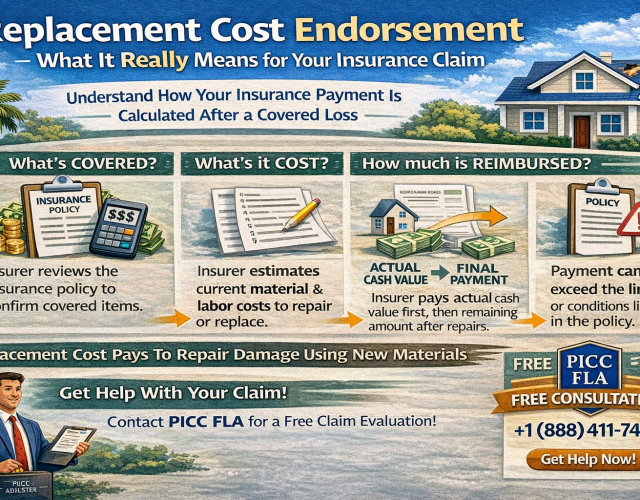
A replacement cost endorsement changes how an insurance claim is valued after a covered loss affects a property. Instead of paying only the actual cash value of a damaged property, the insurance company evaluates the replacement cost value, meaning the cost to replace the item with materials of a similar kind and quality.
Without this endorsement, many insurance policies settle a claim case using actual cash value. This approach subtracts depreciation from the value of the damaged property. In practical terms, this means the cash value payment reflects age and wear, not the real cost of rebuilding or repairing the insured property.
A replacement cost policy works differently. The insurance evaluation considers the cost to repair or rebuild your home or business property using current construction pricing. Replacement cost insurance, therefore, should reflect the real cost of replacing a damaged structure or item, rather than its depreciated market value.
Even with this coverage, however, the insurance industry still follows policy conditions that affect the final payment.
Replacement Cost Does NOT Mean Full Endorsement
Many homeowners’ insurance policies include replacement cost coverage, yet policyholders get confused because they assume the coverage guarantees unlimited rebuilding funds. A replacement cost endorsement does not automatically provide full reimbursement beyond the limits within the insurance policy.
A replacement cost policy pays the cost or actual amount that’s required to restore the asset, but only up to the limit shown in the policy declarations. If rebuilding exceeds that limit, the insurance company may not cover the cost.
This is where the difference between replacement provisions becomes important. Some policies offer extended replacement cost, which increases the limit by a defined percentage. A guaranteed replacement cost endorsement, when available, may allow rebuilding expenses to exceed the policy limit if the policy conditions are satisfied.
Additional clarification explains how these provisions function in practice. A standard replacement cost endorsement still respects the insured limit written into the insurance policy. A guaranteed replacement cost endorsement, however, may allow the insurance carrier to reimburse rebuilding expenses even when the replacement cost exceeds the policy limit, provided the property was insured to value, and the policy conditions were maintained. This distinction explains why two insurance policies with similar coverage can produce very different financial outcomes after severe structural damage.
As a result, two policies with similar replacement cost coverage can produce very different outcomes.
Repair Vs. Replacement. Who Decides?
After a covered loss, the insurance company evaluates the property to determine the most economical solution. According to the insurance policy language, the insurer can repair or replace the affected structure, based on which option produces the lower cost.
If the cost to repair a roof, wall, or structural element is less than the replacement cost, the carrier may approve repairs instead of full replacement. The decision rests on engineering assessments, contractor estimates, and the insurer’s internal estimating systems.
This evaluation focuses on restoring the structure to its previous function. The insurance policy, therefore, requires that repairs use materials of comparable kind and quality, which preserves the original value without funding upgrades.
For homeowners and commercial property owners, this decision affects the final cost coverage and the timeline of the insurance claims process.
The Hidden Conditions Inside Replacement
A replacement cost endorsement introduces several conditions that influence how insurance coverage is paid. These conditions are not always obvious in a homeowner’s insurance policy.
- One condition involves timing. Many policies state that the replacement cost payment is available only after repairs are completed. Until the work begins, the insurance payment may reflect actual cash value, but not the full replacement cost.
- Another condition involves documentation. The adjustment process requires proof that the cost of replacing the damaged property matches the estimates submitted during the claim process.
- Policy language may also limit certain expenses. Debris removal, code upgrades, and environmental remediation sometimes fall outside the standard replacement cost coverage.
These provisions explain why the cost and actual payment structure often involves two stages. The actual cash portion may be issued first, followed by the remaining cash value after repairs demonstrate the final replacement cost.
In many replacement cost claims, this process includes what the insurance industry calls recoverable depreciation. The insurance company first issues payment based on actual cash value, which reflects depreciation. Once repairs confirm the actual replacement cost, the withheld depreciation may be released. For this reason, the initial cash value payment may appear lower than expected.
How Insurance Companies Calculate Repair and Replacement Costs
An insurance estimate is created through a structured evaluation used across the property and casualty sector. The insurance company begins with policy language to determine the scope of coverage, then applies estimating software to calculate the replacement cost.
These systems rely on regional pricing databases that estimate the cost of materials, labor, and construction tasks. The result produces a standardized value for restoring the property.
Although these tools provide consistency, they sometimes differ from contractor estimates. Contractors price work according to current market conditions, material availability, and local permitting requirements. The insurance estimate, by contrast, reflects the pricing structure used by the insurance industry.
This gap explains why the replacement cost value calculated by an insurance estimate may differ from the real cost required to restore the property.
Consumer guidance published by organizations such as the National Association of Insurance Commissioners notes that estimating systems create consistency across large numbers of insurance claims, but individual property conditions and construction realities may still produce valuation differences.
Why Replacement Cost Claims Become Complicated
A replacement cost claim involves several moving parts. Structural damage must be evaluated, the replacement cost of each component must be calculated, and the insurance policy must confirm the coverage for that work.
Hidden damage frequently complicates the process. Water intrusion, electrical issues, and structural movement may appear after repairs begin. Additional work changes the total replacement cost, which then requires updated documentation.
Pricing fluctuations add another layer of complexity. Construction markets shift rapidly, which affects the cost of replacing building materials and labor.
These factors often create disagreement between contractor estimates and the insurance company’s estimate of the replacement cost value.
Why Many Replacement Cost Claims Are Underpaid
Underpayment can occur when the insurance estimate does not capture the full scope of damage or uses pricing assumptions that do not reflect the real cost of repairs.
The insurance company may calculate depreciation, apply exclusions, or remove items viewed as maintenance. These adjustments reduce the actual cash value portion of the payment.
Coverage limits can also affect the final amount. If the replacement cost of restoring the property exceeds the insured limit, the insurance payment may stop at that threshold.
Because the initial estimate often becomes the foundation of the claim, missing details can impact the entire valuation of the damaged property.
Why Handling a Replacement Cost Claim Alone Is Risky
A replacement cost insurance claim involves policy interpretation, pricing analysis, and documentation. Many homeowners discover that the technical language in an insurance policy can be difficult to interpret without relevant experience.
The insurance evaluation relies on internal estimating procedures and claim guidelines. Property owners, by contrast, focus on restoring the property to safe and functional condition.
This difference in perspective creates a risk that portions of the damaged property may be overlooked or undervalued. Without detailed documentation and technical review, differences between contractor estimates and the insurance company’s valuation may remain unresolved.
How a Public Adjuster Helps with Replacement Cost Claims
When disagreements arise about replacement cost, the claim process benefits from independent evaluation. A public adjuster reviews the insurance policy, inspects the property, and analyzes how the replacement cost endorsement applies to the loss.
The review compares contractor pricing, inspection findings, and policy provisions to determine where the difference between the insurer’s estimate and the true replacement cost lies.
Professional claim analysis often includes evaluating the scope of damage, reviewing estimating software outputs, comparing contractor bids, and interpreting how policy language applies to the damaged property.
Documentation then becomes the foundation of the negotiation process. With updated repair estimates, damage reports, and policy interpretation, the insurance company can reassess the value of the claim based on detailed information.
Through this structured review, a public adjuster is certain that the coverage reflects the real replacement cost needed to restore the property after a covered loss.
PICC FLA provides claim support for Florida property owners across multiple types of property damage, including: business interruption (loss of income), fire damage, flood damage, hail damage, hurricane and storm damage, plumbing and water damage, lightning damage, mold damage, roof damage, sinkhole damage, smoke damage, tornado damage, vandalism and theft damage, wind damage, and other property-related losses.
If you are unsure how a replacement cost endorsement affects your insurance claim, contact a PICC FLA public adjuster to review your policy and help ensure the full replacement cost is properly considered.
Frequently Asked Questions
Does replacement cost coverage mean the insurance company will pay the full rebuilding cost?
Not necessarily. A replacement cost endorsement allows an insurance policy to calculate the replacement cost of damaged property instead of the actual cash value, but the payment may still be limited by the coverage limits written in the insurance policy. If rebuilding costs exceed the insured amount, the insurance company may not pay beyond the policy limit unless the policy includes extended replacement cost or a guaranteed replacement cost endorsement.
What is the difference between replacement cost and actual cash value?
The difference between replacement valuation methods lies in depreciation. Actual cash value reflects the depreciated value of a property at the time of the covered loss, while replacement cost represents the cost to replace the damaged property with materials of similar kind and quality. Because of depreciation, the actual cash value payment is usually lower than the full replacement cost value.
Why does an insurance company sometimes pay actual cash value first?
Many insurance policies require the insurance company to issue an initial actual cash value payment before releasing the remaining replacement cost funds. This structure allows the insurer to confirm the real cost of replacing the damaged property after repairs are completed. Once repairs are verified, the remaining cash value difference may be paid.
Can replacement cost coverage apply to personal property?
Yes. Many homeowners’ insurance policies extend replacement cost coverage to personal property such as furniture, appliances, and clothing. Instead of paying the depreciated actual cash value, the insurance coverage may reflect the cost to replace those items with similar products currently available in the market.